Articolo: Earring Twist Back Guide: How It Works and When to Use It
Earring Twist Back Guide: How It Works and When to Use It
You're halfway out the door, hoodie in one hand, keys in the other, and then you feel it. One earring has slipped, the back's gone loose, or the post has caught on your sweater and you're suddenly doing that tiny panic search on the carpet or in the car seat. If you wear studs, dangles, or heavier iced-out pieces, that moment is exactly why earring twist back closures exist.
A twist back is a small mechanical answer to a big everyday problem, keeping the earring from backing off when friction alone isn't enough. It matters most when the piece has real weight, real value, or real sentimental meaning. And because not every back behaves the same way, the right choice depends on how you wear your jewelry, not just how it looks in the box.
The Moment You Almost Lost an Earring
The worst part isn't the noise of the earring slipping, it's the silence after. You reach up, feel one side missing, and suddenly a favorite stud or a gift you wear all the time feels far less secure than it did ten seconds ago. That's the exact problem a twist back is designed to solve, especially when the earring has enough weight to pull at a simple friction back.
A lot of people assume every earring back does the same job. It doesn't. A pushback relies on spring tension, so it can loosen with repeated wear, while a twist-lock style uses a mechanical hold that doesn't depend on the same constant squeeze. If you're wearing a piece that cost real money, or a pair you don't want to keep checking all day, the back matters as much as the front.
Why shoppers keep getting this wrong
The confusion usually starts at the jewelry counter. Someone buys a pair of studs, hears “secure back,” and assumes that means the same thing as “comfortable” or “easy to remove.” It doesn't, and that mismatch is why people end up with earrings that feel fine in the mirror but annoying by lunchtime.
For shoppers choosing diamond studs, Cuban link-inspired statement pieces, or heavier dangles, the back isn't an afterthought. It's the part that decides whether you can wear the earrings confidently, or whether you'll keep touching your ears every few minutes. That's why the mechanism deserves a real explanation before you buy.
What an Earring Twist Back Actually Is

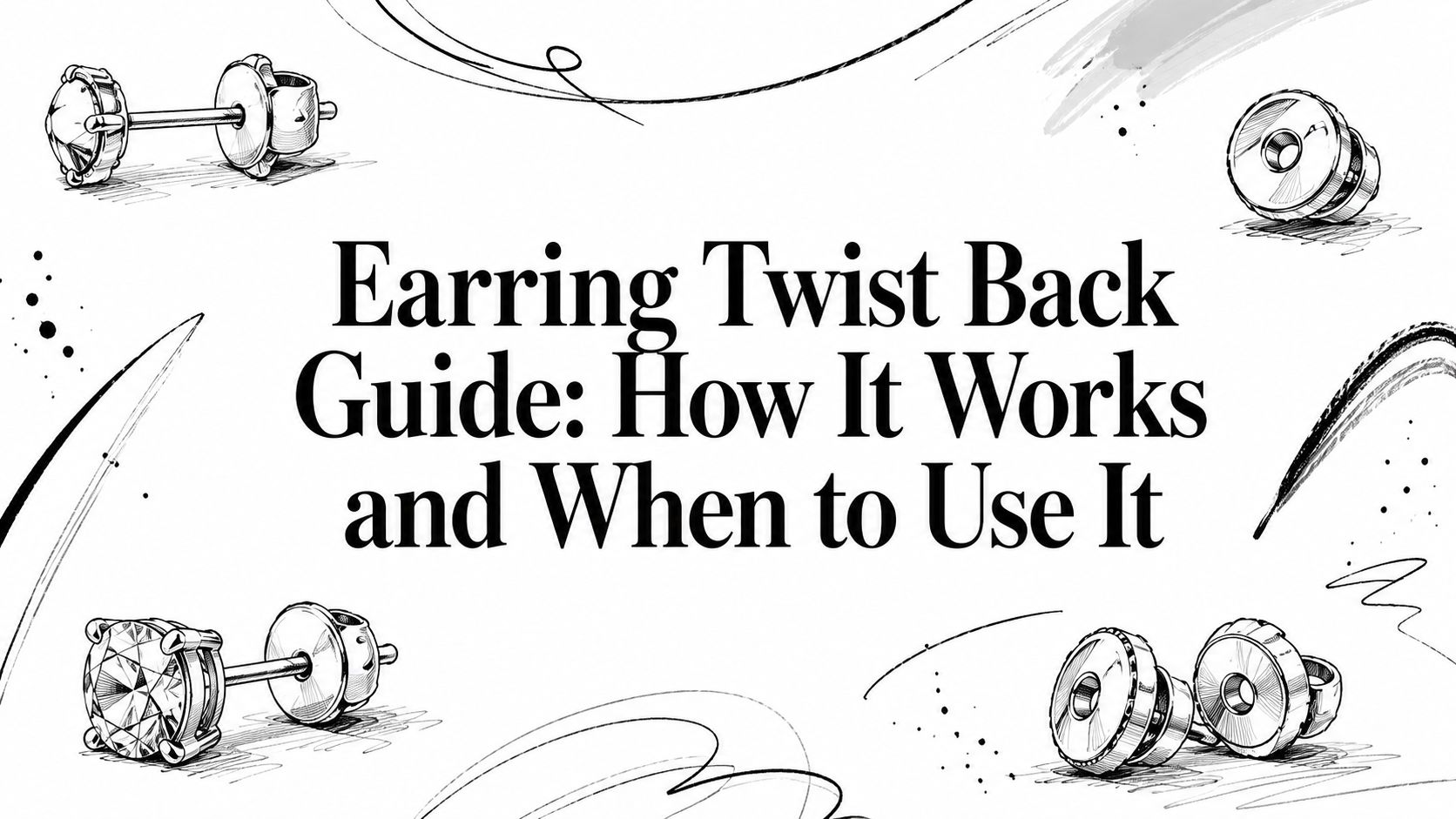
Think of a twist back like a tiny cap that only locks when the parts line up. The post goes through your ear, the connector slides on, and then a short turn lets the locking notch catch. That's why it feels more like fastening a bottle lid than pinching a butterfly back into place.
The modern twist-lock earring back is part of the screw-back family, which jewelry history traces to the late 19th century as jewelers looked for a more secure closure for valuable pieces and heavier earrings. Older piercing methods even used a rotated thread in the healing channel, so the motion itself has a long, practical history behind it. You can read that broader timeline in the fashion history reference on earrings, which places early earrings around 2500 BCE and later fastening innovations over the last roughly 140 years in the history of earring closures.
The three parts that do the work
The mechanism is simple once you picture it in pieces.
- The notched post: This is the straight part that passes through the piercing and gives the back something to grab.
- The rotating connector: This slides on first, then turns so its inner shape meets the notch.
- The securing lock: Once aligned, it stops accidental removal better than a plain friction fit.
Practical rule: If the back only stays on because it's squeezed tight, it's a friction system. If it stays on because the parts interlock, it's a twist-lock system.
That positive lock is the big difference. A butterfly back can loosen if spring tension fades, but a twist back depends on alignment and engagement. That's why it feels more controlled and more intentional, especially on pieces you'd hate to lose.
Twist Back vs Butterfly vs Screw vs Locking
The right back depends on what you're doing while you wear it, not just what the packaging says. If you sleep in your earrings, the shape of the back matters. If you're working out, security matters even more. If you're wearing a heavier stud or a statement piece, retention becomes the main question.
The comparison below keeps the choice practical instead of theoretical.
| Back Type | Speed to Fasten | Hold Strength | Best Wear Scenario |
|---|---|---|---|
| Butterfly back | Fast | Moderate, can loosen with wear | Light everyday studs when convenience matters |
| Screw back | Slower | Very secure | Valuable studs and heavier pieces |
| Twist back | Moderate | Secure with a positive lock | Daily wear when you want security without the slowest fastening |
| Locking back | Moderate | Secure with added retention features | When comfort and hold both matter, especially for certain stud styles |
For a deeper look at low-profile comfort options, the guide to flat back earrings is useful because it shows why some wearers choose a flatter profile for sleep or all-day comfort. That matters when a back sits against the head for hours, because the most secure option isn't always the most wearable.
Real wear scenarios make the choice clearer
A butterfly back is convenient for quick earrings you put on and forget about. It's less ideal when the piece is valuable or heavier, because the hold comes from tension rather than a mechanical lock. A screw back is the security-first option, but it takes more time to fasten.
A twist back sits between those extremes. It gives you a more deliberate lock without the same slow threading motion, so it can work well for people who want speed and peace of mind in the same piece. That said, if you're choosing between styles for sleeping, gym sessions, or heavier iced-out designs, the fit of the post and the shape of the back still matter more than the label.
How to Put On and Remove a Twist Back
The easiest way to learn a twist back is to stop thinking about “putting on the back” and think about one smooth motion. First the parts line up. Then the connector slides into place. Then the turn locks it in. If one part feels awkward, it usually means the alignment is off, not that the earring is defective.

Fastening it without fighting the mechanism
Start by lining up the notch with the post slot. Slide the connector on until it sits close to the earlobe, then rotate it a quarter-turn until you feel the lock engage. That final click or stop is what tells you the system has caught correctly.
Removal is the reverse, but there's one small trick that helps. Pull the earlobe slightly away from the head as you untwist, because that gives the back more room to clear the piercing and prevents tugging. If you've ever felt an earring catch on the way out, that tiny bit of extra space makes a big difference.
Fixing the “it faces the wrong way” problem
Many people believe their twist back is incorrect when the actual issue is orientation. If a dangle sits inward, outward, or at an odd angle, a slight quarter-turn of the post itself can re-center the front so the piece faces the correct direction. This is especially useful for earrings that have a clear left and right side, because the wrong orientation can make the entire design sit backward.
A crooked earring is often an alignment problem, not a closure problem.
If the angle still looks off after a careful adjustment, the shape of the piece may need a different back style or a post customized to the piercing angle. That's the point where fit beats force, and forcing the lock usually makes the earring sit worse, not better.
Choosing the Right Twist Back for Your Style
A good twist back has to match the post, the weight, the ear, and the material. Miss one of those, and the fit starts to feel fussy. Get them right, and the earring sits cleaner, feels steadier, and doesn't need constant readjustment.
If you want a quick example-driven style reference, VVS Jewelry's men's earrings and hip hop style guide shows how earring shape and finish influence the overall look, which is part of the decision before you even think about the back. That matters because a heavy stud, a pendant, and a small everyday piece don't put the same demand on the fastening system.
Four checks that actually matter
- Post gauge: The back has to match the post thickness. If the fit is off, the back can wiggle or fail to lock.
- Earring weight: Heavier pieces need a stronger hold, but very heavy designs can also strain thinner posts.
- Ear anatomy: Piercings don't all sit at the same angle, so the same back can look straight on one person and crooked on another.
- Material and finish: 925 sterling silver, solid gold, stainless steel, and silicone-lined options all behave a little differently against skin and daily wear.
A twist back can be a smart choice for moissanite studs or sterling silver pieces when you want security without turning the fastening into a chore. VVS Jewelry also offers screw back / twist on earring backs for stud styles, which fits the same general idea of a locking closure on a threaded post. The important part is still the fit, not the name on the listing.
When to adjust and when to switch
If the earring faces slightly off, try orienting the post before you blame the back. If the back won't sit flush, or the piece keeps leaning because of weight or angle, that's usually a sign the design needs a different support style. The right back should make the earring easier to wear, not harder to line up.
When a Twist Back Is Actually the Wrong Choice
Secure doesn't always mean ideal. Twist backs take longer to fasten than push backs, and anyone with small hands, long nails, or stiff fingers can find them annoying in a hurry. They also create a bit more pressure against the earlobe than a very simple pushback, which some people notice after a long day.
Sleeping is the clearest test. If you side-sleep, a twist back can feel more noticeable against the pillow than a flatter option, especially on nights when you forget to take your earrings out. In that case, a lower-profile system may be a better fit for comfort.
The material discussion matters too, especially if you're comparing silver and steel for frequent wear. VVS Jewelry's stainless steel vs sterling silver guide is helpful if you're trying to separate style from wearability, because the back and the metal should work together rather than fight each other.
Don't use a twist back when
- You need the fastest possible on-and-off routine: A pushback is simpler.
- You have limited hand dexterity: The twisting motion may feel fiddly.
- You side-sleep in your earrings often: A flatter back can be more comfortable.
- Your post isn't made for a locking system: The mechanism needs the right hardware to work properly.
For a lot of people, that doesn't mean twist backs are bad. It just means they're a better tool for some wear scenarios than others. A heavy stud you wear out at night calls for different hardware than a light stud you pop in before work.
Care, Cleaning, and Long-Term Maintenance
A twist back usually fails from buildup before it fails from drama. Skin oil, soap residue, and hair products collect in the tiny joint where the connector meets the post, and that's when the motion starts to feel sticky or tight. A quick cleaning routine keeps the lock feeling smooth.

A simple upkeep routine
- Regular cleaning: Soak the back briefly in warm water with mild soap, then rinse and dry it well.
- Joint care: Use a soft toothbrush to clear the notch and the rotating area.
- Proper storage: Keep the backs in a divided tray so the small parts don't disappear.
- Periodic inspection: Look for wear on the notch and make sure the connector still locks firmly.
That routine lines up with standard jewelry care advice, including the maintenance basics in VVS Jewelry's jewelry care guide. The goal is simple, keep the mechanism clean enough that it locks the same way every time.
If the twist feels gritty, the back probably needs cleaning, not more force.
Replace the back when the lock no longer feels firm or when the metal shows visible wear. On sterling silver pieces, any green discoloration is a sign the back has reached the point where swapping it out makes more sense than trying to rescue it.
Quick Answers for Twist Back Shoppers
Do twist backs fit any earring? No, they only work with posts made for the notch pattern or ones a jeweler can modify. The fit and post angle notes earlier in the guide explain why a mismatch can make the back useless even when the design looks close.
How tight should a twist back feel? Snug, with no wiggle, but never painful. If you feel pinching, the post length, angle, or size is probably off, not just the fastening motion.
Are twist backs safe for new piercings? Generally not. Healing channels do better with a flatter, lower-movement back, and the moving joint of a twist system can be a poor match during recovery.
Can the lock loosen over time? Yes, wear and buildup can make it feel less secure. Cleaning and periodic replacement keep the mechanism working the way it should.
If you want earrings that stay put without looking bulky, explore VVS Jewelry for stud styles and secure closures that fit streetwear and everyday wear. You'll find pieces that make sense for real use, whether you want a cleaner daily stud or a more secure backing for a heavier look.